
The Two Public Records Systems in Jackson County
Missouri runs public access on two tracks. The Sunshine Law in Chapter 610 RSMo covers county agencies, boards, and committees. Court records are governed by Missouri Court Operating Rule 2. Both share an open-by-default rule. Both list narrow carve-outs. The Sunshine Law also tells each public body to name a custodian and to publish a process for requests under RSMo § 610.023.
The Sunshine Law definitions cover the meaning of public record, public meeting, and public governmental body.
The text is on the Missouri Revisor of Statutes site at RSMo § 610.010.
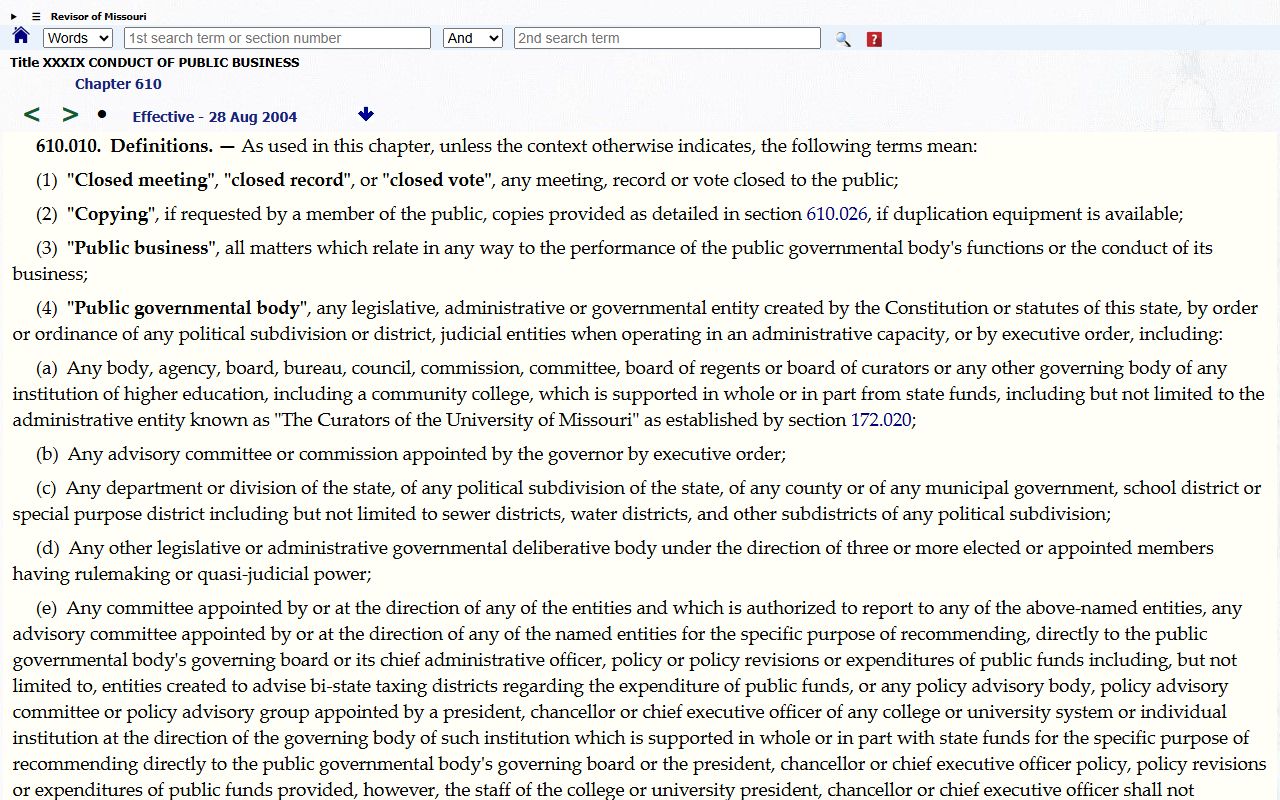
The section sets the meaning of public record, custodian, and other terms used across the rest of Chapter 610.
What Each Jackson County Office Holds
Different files live in different offices. The Recorder of Deeds holds land records, marriage license records, and UCC filings. The 16th Circuit Civil Records department holds civil case files. Criminal Records holds criminal and traffic court files. The County Clerk holds local agency meeting records, election records, and county commission files. The Sheriff holds arrest and incident reports under RSMo § 610.100.
- Deeds, mortgages, plats, and UCC filings: Recorder of Deeds.
- Marriage licenses: Recorder of Deeds.
- Civil, family, small claims, and probate case files: 16th Circuit clerk departments.
- Arrest reports, incident reports, jail roster: Jackson County Sheriff.
- County commission minutes, contracts, and election data: County Clerk.
- Building, zoning, and property data: county departments and assessor.
Searching the Recorder of Deeds Online
Most county document data is searchable for free through the Aumentum Public Access portal. The same portal hosts the marriage index, the real estate index, and the UCC search. No login is needed for public search. An account login adds a basket and copy ordering. For office help on land records, court files, and marriage records, also see the Recorder of Deeds, the Circuit Clerk, and court records.
Open the Aumentum portal to start a record-by-record search.
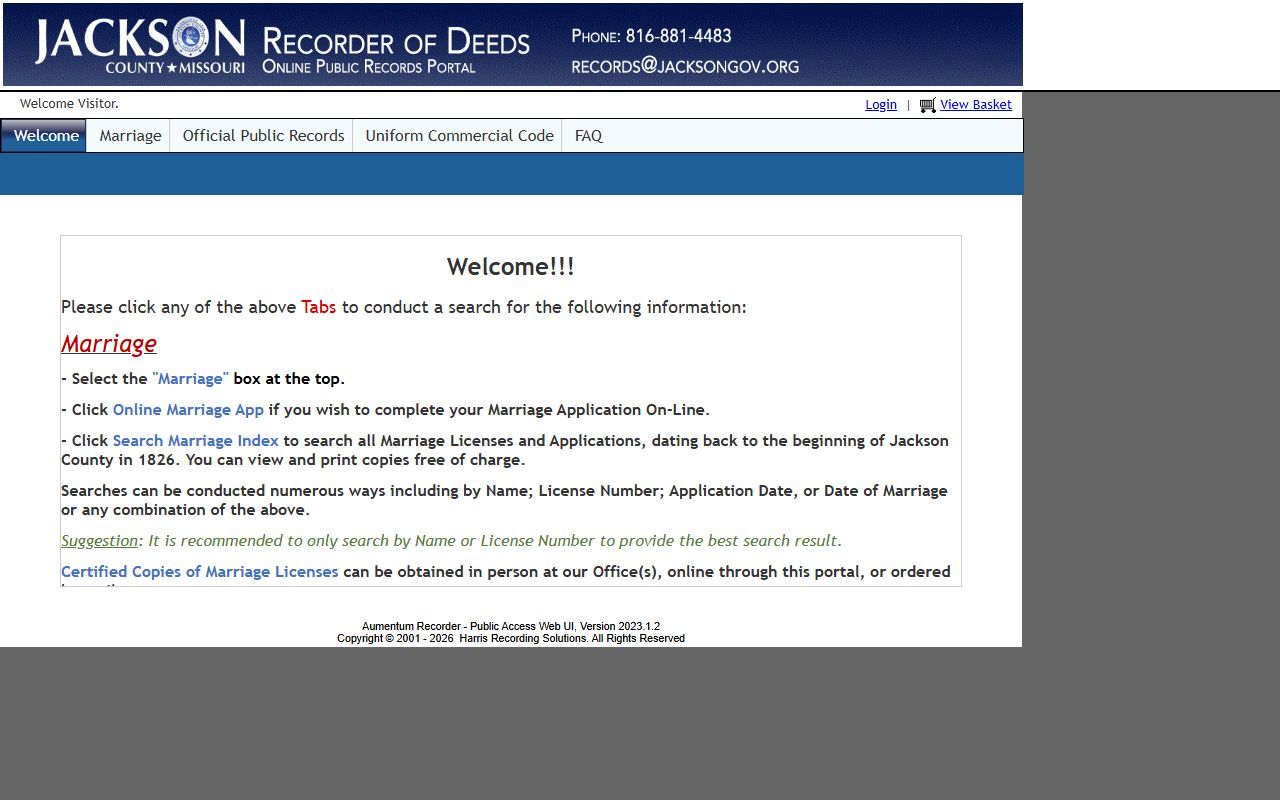
The page menus split work into Marriage, Official Public Records, and UCC. Pick a menu and pick a search mode to find a record.
How to File a Public Records Request
The Sunshine Law gives each county body a process for requests. The basic steps fit on one page. Missouri does not require a special state form. A short letter or email to the right custodian works. Be clear about what you want, the date range, and the format. The body must respond as soon as possible, not later than three business days after the request, under RSMo § 610.023.
- Find the right custodian for the file. County departments name a custodian under state law. Court files use the clerk department for that division.
- Write a short request with your name, your contact info, a clear list of records, and your preferred format.
- Submit by email, by mail, or in person to the custodian's office.
- Wait for the response. The custodian has three business days to respond. The body must either give the records, deny them with a citation, or estimate the time and cost to produce them.
- Pay any allowed fee for copies, staff time, and programming under RSMo § 610.026.
- Pick up the records, get them by mail, or get a download link.
The state policy section reads strongly for openness.
The policy text is on the RSMo § 610.011 page.
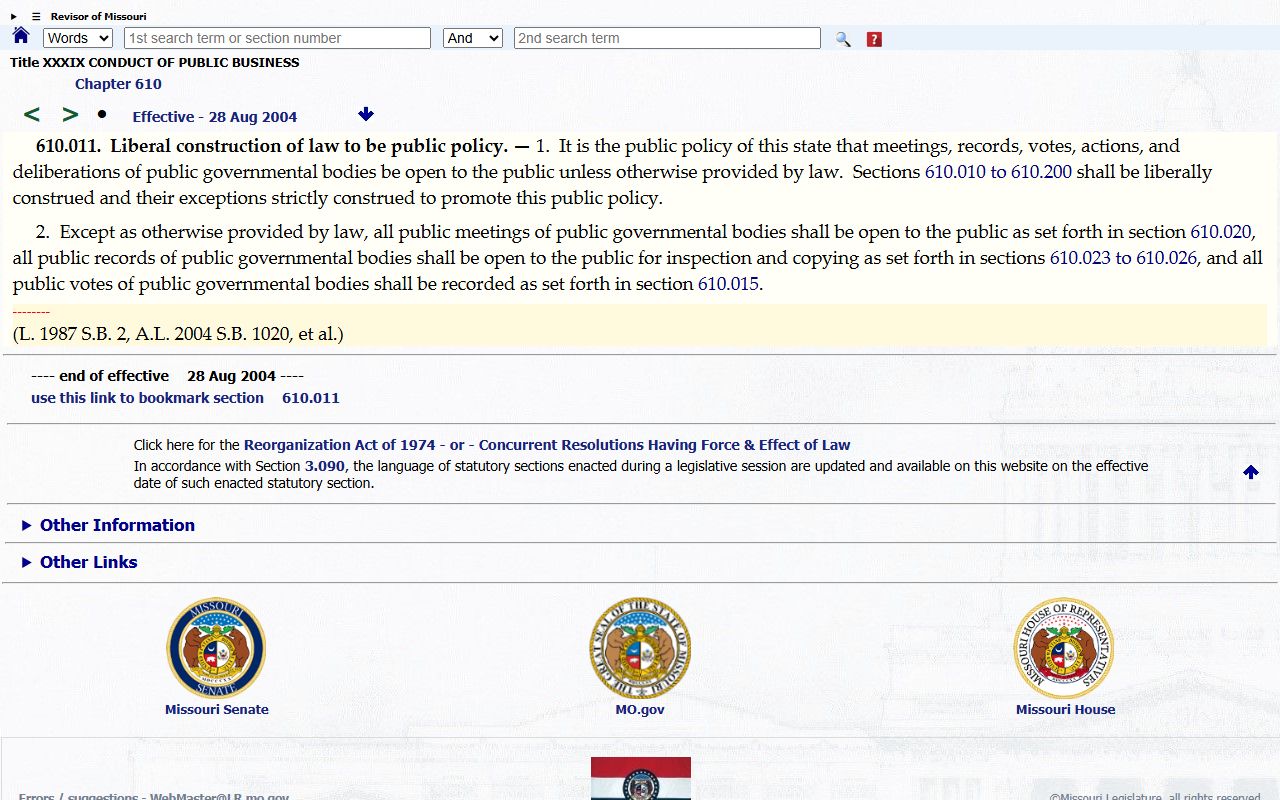
The section says public records are open unless otherwise provided by law and that exceptions are to be read strictly.
What to Put on a Public Records Request
A clean request gets a faster reply. Missouri lets the public ask for records in plain language, but the more clear the request, the smaller the staff time line item. Include enough data for the custodian to find the file without follow-up.
| Field | Required | Notes |
|---|---|---|
| Requester Name | Yes | Use a real name for the response. |
| Contact Method | Yes | Email, phone, or mailing address. |
| Records Description | Yes | List record types, subjects, and any case or file numbers. |
| Date Range | Yes | Narrow date ranges cut staff time and fees. |
| Format Preference | No | Paper, PDF, CSV, or other. |
| Delivery Method | No | Pick up, mail, or email. |
| Custodian / Office | Yes | Direct the request to the right custodian. |
| Fee Cap | No | State a cap if you want the body to call before billing past a set amount. |
Public Records Fees Under Missouri Law
Fees follow RSMo § 610.026. The body may charge for copies, for staff research time at the rate of the lowest-paid clerk able to do the work, and for programming if the record is electronic. The body may not turn the fee into a barrier to access. Court records use court-set copy fees from the court fee schedule, not the Sunshine Law fee rule.
| Item | Amount |
|---|---|
| Per-page paper copy (agency records) | Up to 10 cents per page under § 610.026 |
| Staff research time | Rate of the lowest-paid clerk able to do the work |
| Programming time for electronic records | Actual cost |
| Court record copies | Set by court fee schedule |
| Certified court copy | Set by the clerk department |
| Recorder document copy, first page | $2 |
| Recorder document copy, each added page | $1 |
Note: Custodians may ask for payment of estimated fees up front and may waive small fees in the public interest under state guidance.
Records That May Be Closed
The Sunshine Law allows narrow closures. RSMo § 610.021 lists the categories. Legal actions, real estate negotiations, personnel files, sealed bids, security data, individually identifiable patient and student records, and certain law-enforcement records may be closed. A body must point to the right exception each time it closes a record. Court Operating Rule 2 also closes some court files, including juvenile, adoption, mental-health, sealed, and expunged matters. Each closure is narrow, and the body must keep the rest of the file open if part can be released.
Court Records Run Under Court Operating Rule 2
Court files do not use the Sunshine Law. Missouri Court Operating Rule 2 sets the open-court rule. COR 2.02 presumes case records open, with carve-outs for confidential records, work product, internal court email, and judicial draft memoranda. COR 2.04 lists the public internet index methods. COR 2.09 sets the process for a person to request review when the clerk denies access. To start, write to the clerk department that holds the file. If the clerk denies access, the request moves to the supervising court.
The rule text is on the Missouri court system site.
See the official Missouri Court Operating Rule 2 page for the open-court rule.
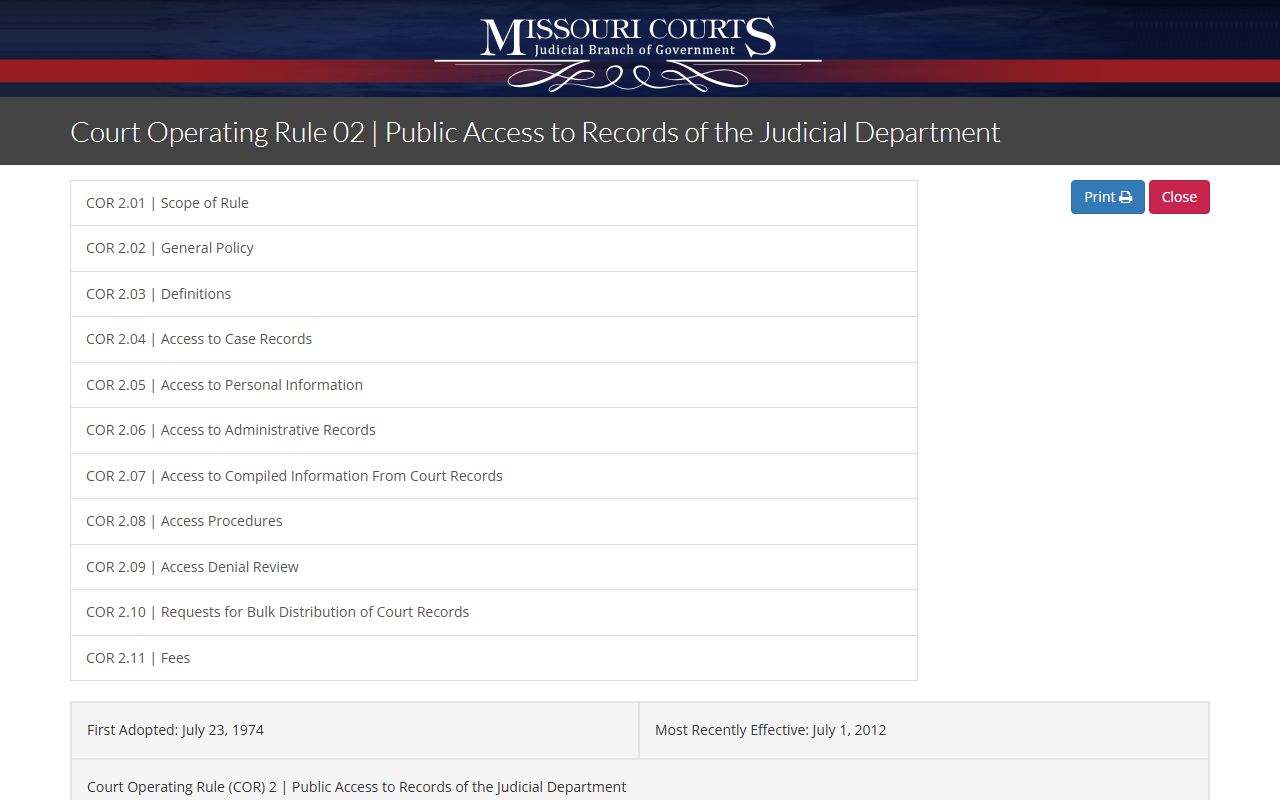
The rule covers what is open, what is not, and the steps to ask for review if a request is denied.
Enforcement and Denials
If a Sunshine Law request goes wrong, the law gives the public a path. RSMo § 610.027 lets a person sue to enforce the law in a state circuit court. A knowing or purposeful violation may carry a civil penalty and attorney fees. For court-record denials, the COR 2.09 review path is the first step. Many disputes get resolved at the clerk level by narrowing the date range, the case type, or the personal-identifier scope.
Response Times for Jackson County Records
The Sunshine Law sets a clear time line. The custodian must respond as soon as possible. The hard cap is the end of the third business day after the request. If the body needs more time, it must give the requester a written explanation and a date when the records will be ready or denied. A partial denial is allowed, but the body must give the open part and cite a statute for any closed part. Court files use a separate path under court rule, and clerk response time can vary by case type.
- Request received: clock starts on the next business day.
- Day 3: deadline to respond, even if the response is a time and cost estimate.
- Partial denial: open part must be released. Closed part must be tied to a statute or court rule.
- Full denial: must cite the statute or court rule that closes the file.
- Cost estimate: due before staff time runs past the requester's stated cap.
Most agency replies arrive in one to three business days for simple requests. Complex requests with broad date ranges can take longer.